The Political Architect
There is a version of this story I have told at conference tables in which the lesson is about stakeholder management. The engagement succeeded. The client was satisfied. That version is true. It is also incomplete in a way that matters.
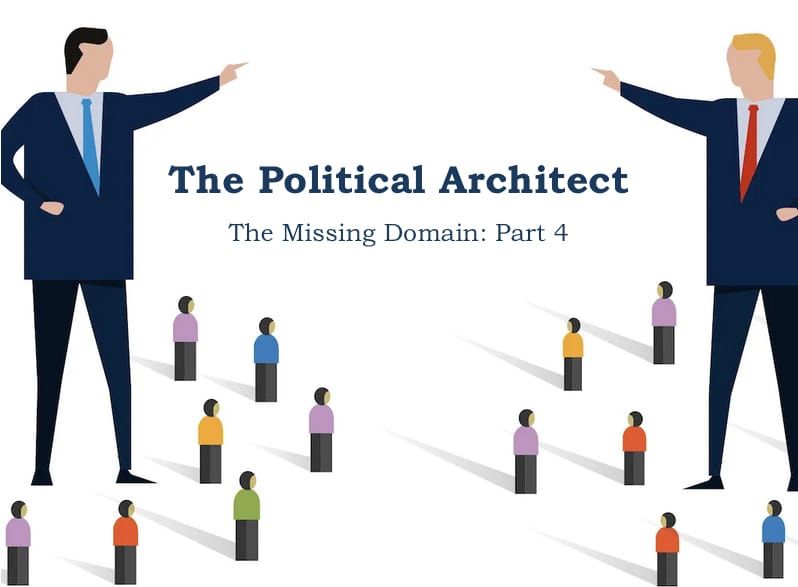
The Missing Domain, Part 4
There is a version of this story I have told at conference tables and in client briefings, in which the lesson is about stakeholder management and the importance of reading the room. The engagement succeeded. The client was satisfied. The capability was built. I learned something about how organisations work.
That version is true. It is also incomplete in a way that matters.
Here is the fuller version.
The mandate
The year was 2010. A well-known UK high street bank, recently rescued from the consequences of the 2008 financial crisis, had made a public commitment to reduce complexity in its operations. Business architecture was a relatively unknown discipline in UK financial services at the time, and on the advice of one of the large management consultancies, the bank had decided to build its own internal BA capability rather than buy it in perpetually. I was asked to join as a senior member of the team.
The project had significant executive visibility. The programme sponsor was a board member, directly accountable for a portfolio of initiatives aimed at simplifying the operating model and restoring the trust of customers who had every reason to be sceptical. The mandate was clear and the appetite, at least in the language of the strategy documents, was genuine: find the complexity, name it, map it, and make it visible so that decisions could be made.
I believed that mandate. I took the Statement of Work at its word. I was, at that point in my career, not yet a political animal.
What the mapping found
The newly formed team set about mapping the current operating model with the rigour the methodology demanded. What we found, as the weeks accumulated into months, was not evenly distributed.
One function alone accounted for more than 70% of the process inefficiencies we catalogued. More than half of the key data objects in that function were flagged as suspect: incomplete, duplicated, or of unknown provenance. Multiple systems were delivering the same capabilities with no rationalisation. Roles existed without job descriptions. Objectives were unclear. Performance metrics, in many cases, were simply absent.
That function was headed by the programme sponsor.
We raised the findings, carefully, with the heads of the relevant teams. The responses were vague, deferred, or absent. And then one of the more approachable Heads took me to one side — I remember the conversation clearly, the change in register, the quality of the silence around it — and offered what I can only describe as a professional education.
He told me about a previous consultancy the bank had engaged. Good people, he said. Competent, thorough, clearly knew what they were doing. They had also been shown the door, because they had taken the Statement of Work literally. “They were not political animals,” he said. “You need to understand the politics here if you want to survive.”
The beer turned to water in my hands.
The choice
I thought about it for a long time after that conversation. Late at night, in the way that the genuinely important decisions tend to surface: not in meetings, not in frameworks, but at the desk after everyone else has gone.
I mapped my own options with the same clarity I had applied to the operating model.
Option one: the logo. A long-tailed engagement with a prominent UK bank. A credible name on the case study list. The foundation of a consultancy practice built on something real.
Option two: the relationship. The comfort of continued access, continued trust, continued work. The kind of institutional familiarity that takes years to build and an afternoon to lose.
Option three: the moment. The short-lived satisfaction of presenting an honest report to a Managing Director of a significant financial institution and letting the evidence speak for itself.
I chose option one. I have not always been comfortable with that, but I am being honest about it here because the discomfort is the point.
The negotiation
Before the draft findings were published, I arranged a one-to-one with the MD. I asked him, directly, how he wanted his organisation depicted in the report.
He had a clear view.
I shared some of our findings. Sugarcoated, selectively framed, stripped of the pattern that made them meaningful in aggregate. The 70% figure did not appear. The suspect data did not appear in the terms we had documented it. What appeared instead were a set of minor, tractable issues: the kind that could be acknowledged without threat, actioned without structural change, and resolved in a way that generated a progress update rather than a reckoning.
He approved them. We negotiated, collegially, a version of the truth that neither of us had to defend very hard.
At the end of the engagement, everyone was satisfied. The bank had a business architecture function and a set of findings it could manage. I had a named engagement with a prominent institution and the beginning of something I could call a practice. The MD, in due course, was promoted for exemplary service. He subsequently became the chairman of another financial services institution in the UK.
The complexity we had mapped remained, as far as I am aware, exactly where we had found it.
What silence produces
I want to be precise about what I am, and am not, claiming here.
I am not claiming that the outcome of that engagement was uniquely bad. It was, by the standards of the industry at the time, an ordinary result. The engagement ran, the deliverables were produced, the client was satisfied, and the work contributed to a reputation that subsequently made other, better work possible. By the conventional metrics, it succeeded.
What I am claiming is that the silence had a shape, and that shape had consequences.
The MD’s function contained, at the point of our mapping, a concentration of structural risk that had not been named at board level. By choosing to present a version of the findings that he could approve, I became one of the people responsible for that risk remaining unnamed. The capability map that could have been the basis for a genuine reckoning became instead a document that confirmed a narrative he had already decided upon.
And the system rewarded everyone who played their part. The MD for managing his stakeholders effectively. Me for learning to manage mine. Neither of us was held accountable for the gap between what the mapping had found and what the report described. The accountability structure, such as it was, had no mechanism for that kind of discrepancy. Nobody was asking.
That is the structural condition this article is about. Not the individual choice, mine or anyone else’s, but the absence of any professional norm that would make the choice differently constrained.
The architecture of silence
The problem is not that architects lack integrity. Most of the practitioners I have worked with over two decades are thoughtful, capable, and genuinely committed to the work. The problem is that the profession has built no structure that would make integrity the path of least resistance, and every structure that makes the negotiated truth the rational default.
Medicine has a duty of candour. Law has professional obligations that create personal liability for the practitioner who buries a material finding. Audit has independence requirements, enforced externally, that exist precisely because the incentive structure of a client relationship would otherwise produce exactly the kind of negotiated truth I have just described. Those frameworks are imperfect — medicine and audit both have their documented failures of institutional silence — but their existence at least creates a structure within which the honest practitioner has something to appeal to and something to stand behind.
Business architecture has none of these. No professional obligation to name what the mapping finds. No independence requirement that sits outside the client relationship. No norm that makes the honest report the default rather than the exception.
In that vacuum, the choice I made in 2010 is entirely rational. It is what a sensible person in that position, with those career incentives, in that institutional context, would do. That is not a defence of the choice. It is an argument that the choice should not have been mine to make alone, in the way that it was.
The architect who goes into an engagement, maps the enacted culture, and finds that the worst numbers belong to the sponsor’s own function is not in possession of a neutral set of facts. They are in possession of a document that, published faithfully, will end the engagement and damage the relationship. They are also in possession of a professional credential that confers no obligation to publish it faithfully and provides no protection if they do.
The rational choice, in those conditions, is silence. Not cowardice. Not laziness. Silence as the output of a system that has made honesty professionally optional and complicity professionally rewarding.
The question this leaves
The MD I negotiated with in 2010 became chairman of another financial services institution. I do not know what he brought with him from that bank. I do not know whether the assumptions that produced a function with more than 70% process inefficiencies and a culture of managed findings travelled with him, or whether the intervening years produced a different result.
What I know is that nobody asked. And that the discipline I was practising had no mechanism for asking, no obligation to ask, and no protection for the practitioner who asked and was shown the door for it.
That is the second version of the intangibility defence. Not the epistemological version, which Article 3 addressed. This one. The version that says: I know what I found, and I know what naming it would cost, and the profession has given me every incentive to find something else.
Article 5 proposes that culture should be the first component mapped in any architecture engagement, before capability, before process, before system. This article is the argument for why that is not a methodological preference. It is a structural necessity.