Three Cultures, One Organisation
Every organisation has three cultures. The one in the mission statement. The one in the policy documents. And the one that shows up when the stakes are real. Most transformation programmes design for the first two. The third one is the one that decides whether your programme lives or dies.
The Missing Domain, Part 2
The meeting started well. We had been engaged by a well-known UK high street retail bank in 2015, and the capability mapping work had landed cleanly with the senior leadership team. The next phase was to map those capabilities to people, processes, data and systems to identify rationalisation opportunities. It was exactly the kind of work the engagement had been commissioned to do.
One of the Directors offered to go first. He described himself as a champion of cost-saving. His department, he said, would be the ideal place to start. We took him at his word.
My team worked meticulously. We mapped the capabilities of every resource in the department, cross-referenced the findings, and identified significant redundancy. There were far too many people carrying similar capabilities. We had, as we saw it at the time, hit the jackpot. A 25% reduction in roles, no impact on throughput, and a number of process workarounds automated as a direct consequence. We had done what we had been asked to do, and we had done it properly.
We presented the findings. Partway through, the mood in the room changed.
The Director was visibly unhappy. In the one-to-one that followed, his criticism was vocal. It became clear, with some speed, that his commitment to cost-saving did not extend to reducing the number of people who reported to him. Within weeks, the results of our work had circulated through the senior leadership community in ways we had not anticipated. Our pipeline at that bank dried up.
As far as I know, the capability map is still there. Still unmapped to the organisation’s resources. A technically correct artefact, sitting in a presentation, connected to nothing.
I have thought about that engagement many times since. Not because it was unusual. Because it was completely ordinary.
The three cultures your programme will meet
Every organisation carries three cultures simultaneously. Understanding the difference between them is not an academic exercise. It is the most practically important thing a practitioner can know before they design anything.
The first is the Desired Culture. This is the culture the organisation intends to become. It lives in the mission statement, the vision document, the strategy deck, and the glossy values posters in the reception area and the boardroom. It is aspirational by definition. Nobody is expected to have fully achieved it yet. That is, in fact, part of its function. It gives the organisation something to point towards.
The second is the Espoused Culture. This is the culture the organisation professes to practise right now. It lives in the policy documents, the employee handbooks, the behavioural frameworks, and the way senior leaders describe themselves when asked. The Director who calls himself a champion of cost-saving is describing his Espoused Culture. He believes it. He is not lying. He has, in all probability, made decisions that felt consistent with it.
The third is the Enacted Culture. This is the culture the organisation actually practises, observed in what people do when the stakes are real. It lives in how decisions get made under pressure, how resources get defended when they are threatened, and how the stated values perform when they conflict with immediate self-interest. The Director who commissioned the capability mapping work and then buried the results when they pointed at his own headcount was enacting his culture. Not the one he had described. The one that was actually there.
The gap between the Desired and the Enacted culture is one that most organisations acknowledge, at least in theory. Bridging that gap is what most transformation programmes claim to be for. But that is not where programmes die. Programmes die in the gap between the Espoused and the Enacted, and for a simple reason: most programmes are designed against the Espoused culture, not the Enacted one.
We designed our recommendations for a Director who championed cost-saving. That Director existed. He existed in his own mind, in his policy positions, in the language he used with his peers. What we had not mapped was the Director who existed in his office, in his relationship to his own authority, in his understanding of what headcount meant to his standing in the organisation. Those were two different people, operating in the same body, and we had designed for the wrong one.
The change levels that decide what lands
Knowing which culture you are designing against is necessary but not sufficient. The second variable is where your change programme is actually operating.
Change in any organisation moves through three levels, and genuine transformation requires all three.
The first is Cognitive change: the level of thinking, understanding, and rational agreement. A governance workshop where the senior team nods through a capability rationalisation plan is producing cognitive change. The plan is understood. The logic is accepted. Nobody has left the room having changed what they actually do. In regulated financial services, this is the level at which most programme steering committees operate: informed, aligned on paper, and entirely untested until the decisions begin to cost something.
The second is Behavioural change: the level of practice, what people actually do, day to day, in their real roles. Behavioural change is harder to produce and much harder to sustain than cognitive change, because it requires people to operate differently in conditions that have not fundamentally altered. A branch manager who has agreed in principle to a new customer onboarding process will return to the previous method the moment the system is slow, the queue is long, and the compliance officer is not in the building. You can agree with a model in a meeting and enact the opposite an hour later.
The third is Emotional change: the level of genuine buy-in, the internalised belief that the change is right, that it serves something the individual cares about, and that it is worth the disruption it requires. Emotional change is not sentiment. It is commitment under pressure. The Defence organisation that puts recruits through a physical regime before explaining the strategic rationale is working backwards through the levels deliberately: it produces behavioural compliance first, and grounds the cognitive rationale in embodied experience. Most financial services transformation programmes do the opposite, presenting the PowerPoint rationale and expecting the behaviour and the belief to follow. They often do not.
For change to last, all three levels need to be addressed. An organisation that achieves cognitive and emotional change without behavioural change produces beautiful documents that nobody acts on. One that achieves cognitive and behavioural change without emotional change produces activity without belief, and the moment the external pressure lifts, the previous behaviours return. One that reaches behavioural change without the cognitive and emotional foundations produces compliance without understanding, which breaks down the moment circumstances require judgment rather than procedure.
Where most programmes actually operate
Here is the uncomfortable truth that the intersection of these two frameworks reveals.
Most transformation programmes are designed at the Espoused/Cognitive intersection. The design is pitched at the culture the organisation says it has, delivered through a medium that produces rational agreement. Leadership workshops, steering committees, strategy communications, capability maps presented in boardrooms. All of it operating at the level of what people say and think.
That intersection is not wrong as a starting point. Cognitive engagement with the Espoused culture is where shared language gets built, where a programme earns its mandate, and where the initial alignment that makes anything possible first gets established. The problem is not that programmes begin there. The problem is that most programmes also end there. The Espoused/Cognitive intersection becomes the programme’s permanent home: an address that is comfortable, measurable, and entirely disconnected from the conditions under which the Enacted culture actually operates.
The Enacted culture, by contrast, lives at the Behavioural and Emotional levels. It is what people do when the stakes are real and how they feel about what is being asked of them. Reaching it requires different instruments entirely: the difficult conversation that names the actual conflict, the design process that involves people in decisions that affect them before the decisions are made, the governance structure that creates accountability for cultural behaviour rather than just for programme milestones.
The bank engagement failed not because the capability analysis was wrong but because the work was operating at the Espoused/Cognitive intersection while the Director’s resistance was operating at the Enacted/Emotional one. We were speaking to the culture he described. The culture that responded was the one he enacted. Those two cultures were not in the same room, and we had only prepared for one of them.
The matrix
Plot the three cultures against the three change levels and you have a nine-cell diagnostic.
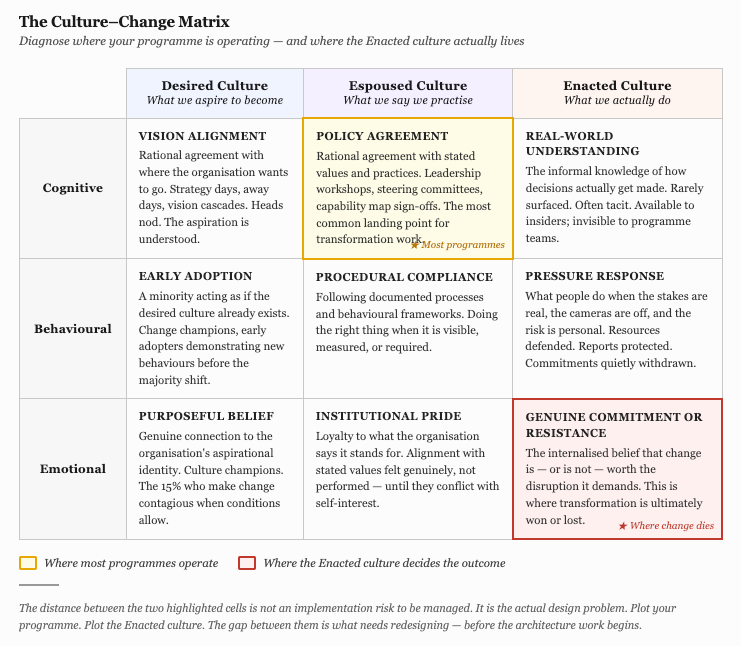
The matrix is not a framework for producing better PowerPoint decks. It is a question before the design work begins: which cell is this programme actually operating in, and which cell is the Enacted culture sitting in? The distance between those two coordinates is the design problem. Not a risk to be noted in an RAID log. The actual problem.
In the bank engagement, the programme was in the Espoused/Cognitive cell. The resistance that ended it was in the Enacted/Emotional cell. Those two cells are on opposite corners of the matrix. We were not merely miscalibrated. We were designing in entirely the wrong register.
The framework problem and the honesty problem
It would be convenient if the failure described above were purely a tools problem. The architect did not have the right framework, so the engagement failed. Give architects this matrix and the problem is solved.
That is only half the story, and probably the less important half.
There is a second, harder problem sitting alongside the framework gap, and it is an honesty problem. Some architects, in some engagements, can see the Enacted culture clearly enough. They read the room. They notice the Director’s discomfort. They sense the resistance forming before it is named. And they design for the Espoused culture anyway, because naming the Enacted culture out loud would put the engagement at risk, or the relationship with the sponsor, or the renewal of the contract.
Those are different problems. The architect who lacks the framework to see the Enacted culture needs better tools. The architect who can see it and chooses not to name it needs something else: a professional norm that makes surfacing that observation part of the role rather than a career risk.
The discipline has not built either of those things into its reference models. That is the argument at the centre of this series.
The framework the discipline is missing
Before a programme maps a single capability, it should be able to answer two questions. Which culture is this programme actually designing for? And at which change level is the intervention being pitched?
Plot those two answers on the matrix above. Mark where the programme is currently operating. Then mark where the Enacted culture sits. The distance between those two points is the real design brief. The programme needs to close that gap before the architecture work begins.
This is not a replacement for capability mapping, value stream modelling, or operating model design. It is the work that should precede all of it, and currently precedes none of it. Not because the tools do not exist. Because the discipline has not built it into its reference models, and because the architects who could name the gap sometimes choose not to.
The bank’s unmapped capability map is one piece of evidence for both parts of that argument.
The next piece looks at whether culture can actually be mapped with the rigour the discipline demands, and examines the frameworks that suggest it can. The intangibility defence, it turns out, is less solid than it appears.