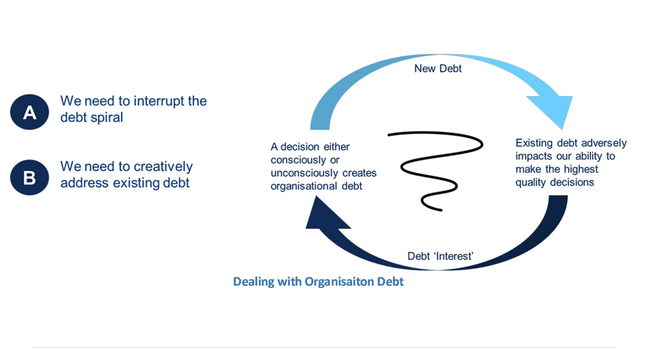
Dealing with Organisation Debt
With thanks to my colleague, Ron Baillie for his inputs on this article. The ideas expressed in this article are reflective of organisations in general and is not reflective of any past/current business that I have been associated with.
Organisation Debt?? Hmm! I will excuse you from thinking that I mean Technical Debt! Or even financial debt! I did the same when I came across this term. But I do mean Organisation debt. And believe me, it is not a new type of debt, or a new phenomenon or even a new coinage. Still interested, let's move on!
What?
Organisation debt is the result of all the decisions and actions that should have been done to ensure an organisation is operating at its peak - but weren't. As these micro-drifts (explained later on) accumulate, They adversely and often imperceptibly impact the operating model of an organisation, slowing it down - one gear at a time - eventually reducing the efficiency, agility and even long term viability.
Most of us (as least those working in IT) would be aware of the term technical debt. Organisation debt is similar but not the same. Technology practitioners are aware of what technical debt is, and are also aware of why and how it is created, notionally aware of the problems that it is causing, and have a good idea of what it takes to solve it. Conversely, organisation debt, to a large extent is relatively unknown. We know things are not right, but do not know why. We don’t know what is causing our (otherwise) great people and (efficient) processes to operate sub-optimally. And we try to find fault with the data and technology and other causative factors. We may start some change initiatives to fix the problems and the end results may not provide the desired outcome.
In today’s fast-moving and ultra-competitive business world it is extremely important for us to be aware of, acknowledge and take steps to fix organisation debt.
Why?
So why do we have organisation debt in the first place? As mentioned above, organisation debts result from the accumulation of micro-drifts. And what are these micro-drifts? Micro-drifts, typically, result from:
- Easy/hasty decisions: easier tactical decisions over harder strategic decisions or expedient decisions 'in the moment'
- Speed: short-term advantages being sought at the expense of 'doing things right', lack of prioritisation, delayed decisions
- Silos: Changes designed and delivered in one part of the organisation (say a business unit) without considering its impact on other areas, or perhaps, similar changes happening in multiple business areas leading to efforts and capabilities being duplicated
- Legacy: Out-of-date hierarchies, legacy policies and structures which worked well in the past but are no longer relevant to current business model
- Out-of-touch: decision makers far removed from seeing how work gets done.
Overtime, these micro-drifts result in processes, structures, policies and even capabilities being misaligned to the operational realities, slowing things down, or in worse cases, being counter-productive to value delivery mechanisms.
Think of the number of change initiatives that have been undertaken in your organisation to 'speed things up', 'remove inefficiencies', 'operate at peak'…. But have addressed the symptoms rather than the root causes (the micro-drifts!).
How do you recognise organisation debt?
Whether large or small, new or old, no organisation gets everything right, and no organisation can keep things constantly working perfectly in the face of changes in the market, in regulation, in technologies, or in the workforce. So at any one time, all organisations will have issues, inefficiencies, and all manner of problems that beg updates to the way the organisation works. But what makes some of these issues ‘debt’ versus something that just needs modifying? The answer is the same as in the world of finance… Debt accumulates interest. If a debt is not paid off, not addressed, it accumulates interest and makes the debt exponentially bigger over time. If organisational debt is not identified, understood at its roots, and then addressed, it causes more debt. One of the obvious ways to recognise organisational debt then is to look for where the compounding interest is being generated.
Elements of an organisation that might have worked fine in the past, but are not longer fit for purpose, if not updated or modernised, become debt because they begin to hamper or adversely influence new decisions or other necessary change. And some decisions which were at the time known or understood to be sub-optimal or expedient will also accumulate interest if not remembered for future redressing.
There are some manifestations of organisational debt that can become very difficult not only to be recognised but also to address because the senior and middle managers who need to recognise and step up to fixing the debt may have themselves benefitted from this debt over time. Organisational structures and hierarchies for example, which served yesterday’s business model, and helped to advance the careers of now senior business managers, may be a significant and damaging mismatch for today’s business imperatives. Not only does this kind of debt need to be recognised, addressing it, especially in large mature organisations, require top management to offer a ‘safe’ way for the layers of management to take an honest ‘step back’ examination of the company’s evolution.
Why deal with organisation debt now?
I think the answer is obvious; because existing debt is already accumulating interest, and because both the debt and the interest become harder to recognise and address over time. In many cases, debt and interest can become ingrained in an organisation to the extent that it is accepted as the organisation culture. The often quoted maxim of ‘culture eating strategy for breakfast’ is a signpost to how damaging this can be.
Next time when you think/plan for a new change initiative, think organisation debt. Think of the micro-drifts and assess if the issue that you are trying to solve may have its genesis in an existing micro-drift. Think carefully whether what you are trying to fix is a symptom of an organisation debt, or the debt itself. If you need to be effective and competitive, you not only need to aware of organisation debt, but be ready to interrupt the 'debt spiral'. Let me rephrase it again. You need to (a) interrupt the debt spiral, and (b) you need to creatively address the existing debt.
Interrupting the Debt Spiral
Raising Awareness: a key issue with organisation debt is that people have learnt to live with it. It has become a way of work-life - embedding itself in your ways of working. It's not that your employees are not aware of it; they have become immune to the micro-drifts to the extent that it goes unchallenged. How may process documents, SOPs, policies exist in your organisation that have not been updated for some time? Do your existing structures support or impede value delivery? When was the last time job descriptions in your organisation were updated to reflect changing value expectations? Essentially, get people to recognise the micro-drifts as interest on existing debt, and then report what they see.
Building a backlog: Organisation debt is hidden and deeply embedded in your organisation's ways of working. Identifying debt itself is daunting. You need to start building a 'debt backlog' of identified and the incremented debt interest that can be considered for later remediation. A good practice is to build an identification and recording process to ensure it is captured (if not addressed!). Depending on the size and expanse of your organisation you may need to federate this activity to your business areas/units, but I would certainly recommend a central pan-organisation backlog to prioritise their remediation based on their impact.
Pinpoint patterns: Look for patterns of commonality and root cause in the debt / interest backlog to surface patterns of causation. Not only will they help you understand the root cause(s), but they will clearly help in prioritisation.
Propose change: Prioritise the root causes and enforce their mitigation in your change framework. A good practice can be baking the remediation into a future change initiative relevant to the root cause or the business area. Incentivise business users to reduce their organisation debt. Your IT colleagues handle their technical debt in a similar way. Learn from their experience and follow their best practices.
Addressing existing debt
Identify: A starting point is to identify the existing debt in your organisation. As mentioned above, it may not be obvious, as organisation debt is embedded in your ways of working. Seek external help. Get change consultants, business architects or similar roles (who are 'external' to your business area/unit) to undertake this exercise. A business architect or change consultant works best as they are internal to your organisation (while being external to your team). They understand your organisation culture and have the capability to identify 'anomalies'.
Assess: Assess the impact of individual items on the organisation (or business unit). Identify options for its mitigation.
Sell: Build a business case for its mitigation and sell it to your leadership.
Manage: Work with your change colleagues to implement the mitigation or remediation of the organisation debt and evidence it.
It’s not about finding faults
An exercise to identify organisation debt can lead to a blame game. We need to be aware of this and steer clear from naming and shaming. A micro-drift could have happened for a number of reasons which would have seemed quite reasonable at the decision time, but not so in hind-sight. Being aware of organisation debt and taking steps for its mitigation is often the sign of organisation maturity. It is about:
- Driving strategy alignment so that we do not operate in old silos
- Being more conscious of the implications when making decisions
- Spending enough time on the business case - 'thinking it through'
- Maintaining the organisation's myriad business components in terms of fitness-for-purpose
- Keeping the 'Big Picture' at the centre of design and execution, and above all,
- Building a new way of working which is aligned to current value expectations
Talking with some of my colleagues in IT, I was amazed at their 'contentment' having solved some of their technical debt. It is a positive step which is valued across the many parts of the IT team. I believe business users will feel a similar sense of satisfaction having helped to identify and mitigate organisation debt. Try it, there's hardly anything to lose and a lot of satisfaction coming your way.