Data Rich, Information Poor - The Insurance Industry's Hidden Problem
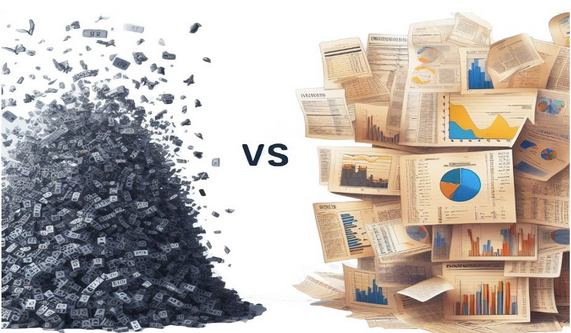
Most insurers proudly declare that they are “data-driven.” With vast amounts of policy, claims, customer, and risk data collected every second, the industry is awash with information sources. Yet scratch beneath the surface and a paradox emerges: insurers are data-rich, but information-poor.
Why? Because data alone is not enough.
In most organisations, data is treated as an IT domain—something stored, secured, and reported on. What often gets overlooked is business information: the contextualised, meaningful representation of data that business users rely on to make decisions, deliver value, and run processes efficiently.
Without this context, data becomes noise rather than insight.
The Symptoms of Information Poverty
The lack of a common business glossary is one of the biggest culprits. When “Customer” means one thing in underwriting, another in claims, and yet another in finance, the enterprise ends up with:
- Duplicate processes across departments, each solving the same problem differently.
- Duplication of data, with multiple “sources of truth” that never fully reconcile.
- Duplication of MI, where the same report exists in five different formats, all slightly misaligned.
These inefficiencies aren’t just an operational burden—they erode customer trust, drive up cost-to-serve, and make it harder to comply with regulatory demands.
Why This Matters Now
In a world of embedded insurance, Open Finance, and AI-enabled underwriting, the stakes have never been higher. Data without context cannot drive intelligent decision-making, enable real-time experiences, or build resilience against regulatory scrutiny.
Business information, not just raw data, is the foundation for:
- Transparent operating models.
- Streamlined reporting and MI.
- Better customer and partner experiences.
- Sustainable digital transformation.
This is just an introductory article. It makrs the beginning of a series examining the business information gap in the insurance industry, coming out of discussions I am having with a number of professionals. Over the coming weeks I will cover:
- What exactly is business information, and how does it differ from data?
- How organisations can progress from information to knowledge to wisdom.
- The cost of duplication when no common glossary exists.
- Why a Business Information Model is the key to reducing redundancy and unlocking value.
And I'd like to end with a challenge. If your organisation claims to be "data-driven", ask yourself this: do you truly have business information, or just raw data scattered across silos?