From Journey Maps to Value Streams: Unifying CX, Business Architecture and AI Delivery
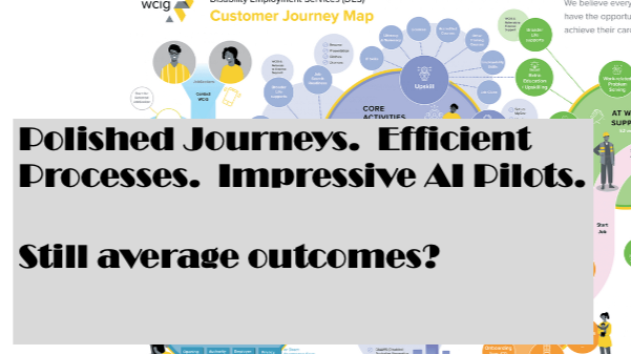
Most enterprises run three parallel conversations. CX teams craft journey maps and moments-that-matter. Business Architects model value streams and capabilities. Data & AI teams pursue “use cases” where the data is convenient. Each stream is rational in isolation — yet together they create a three-speed organisation where experience, flow, and intelligence rarely synchronise. The result is predictable: polished touchpoints that do not move economics, operating models that don’t reflect how customers actually experience the firm, and AI pilots that demonstrate accuracy yet fail to change outcomes.
Keeping these strands separate drives structural failure modes:
- Competing narratives and priorities: CX promises (“frictionless, real-time, transparent”) outpace the enterprise’s capability and data fitness; AI roadmaps chase tractable data rather than the biggest value constraints; architecture is forced to mediate after the fact.
- Fragmented metrics and incentives: CX reports NPS and effort; Operations targets throughput and utilisation; AI reports model accuracy. None of these, alone, guarantee time-to-value, right-first-time, cost-to-serve, or leakage improvements. Teams optimise their metric and inadvertently sub-optimise the end-to-end flow.
- Sequential, slow delivery: Work moves journey → process → model in hand-offs. By the time AI arrives, policies have shifted, data labels are stale, and the economics have changed. Lead times stretch from weeks to quarters; value evaporates in review cycles.
- Decision ambiguity: No single owner for the critical decisions inside each stage (triage, coverage validation, settlement, recoveries). Policies live in PDFs; processes in SOPs; models in notebooks. Without a decision architecture, explainability, fairness, and accountability are brittle.
- Information incoherence : Journey events, process steps, and enterprise data models are named, owned, and measured differently. AI then “optimises noise”: impressive precision with little business relevance.
- Funding and platform sprawl: Portfolios fund projects and channels, not value-stream constraints. Point tools multiply, integrations duplicate, and tech/operating-model debt compounds.
- Risk in the wrong forum : Model risk is debated away from the business outcomes it influences. You get caution without clarity: either unsafe acceleration or a perpetual pilot purgatory.
The compounded impact is material: slower time-to-value, higher rework and failure demand, sustained cost-to-serve, “pilot theatre”, and regulatory exposure (because you cannot evidence how decisions were made end-to-end). Morale suffers as teams ship activity without outcome uplift; customers notice promises that feel good in the app but collapse in the back office.
There is a better way. Value streams provide the spine that connects customer moments to enterprise flow and the decisions where AI should act. When CX aligns moments to stages, BA anchors capabilities and data products to those stages, and AI is placed deliberately on stage-level decisions with human-in-the-loop patterns and outcome-tied metrics, experience and economics move together — by design, not by chance.
Journey map, value stream, process: different instruments, one score
On their own, journey maps risk theatre. Processes risk local optimisation. Value streams connect the two and create the governance spine for AI to earn its keep.
A unifying approach in five moves
- Start with the promise, not the artefacts Name the stakeholder and the outcome: e.g., “A motor policyholder settles a valid claim quickly and fairly.” This becomes the shared charter for CX, BA, and AI.
- Align moments to stages Map each moment that matters to a stage of value. Keep stages to 6–10 outcome-bearing waypoints. This prevents relabelling departmental steps as “stages” and avoids journey theatre.
- Blueprint capabilities and data products by stage For each stage, list the capabilities that do the work and the core information objects they depend on. Treat those information objects as data products with owners and quality/timeliness SLAs. Without information fitness, AI optimises noise.
- Design the decision architecture and place AI deliberately Inventory the micro-decisions in each stage. Classify risk and cadence. Decide which are rules-based, model-driven, or judgement-led. Define human-in-the-loop patterns and promotion gates (assistive → supervised → straight-through) based on outcome risk, not hype.
- Measure one system, not three Tie CX metrics to value-stream flow and economics. Track time-to-value, right-first-time, failure demand, cost-to-serve, and leakage at stage level. For AI, add decision latency, override rate, drift, and fairness checks. If end-to-end outcomes don’t improve, the initiative hasn’t delivered.
A concrete insurance example: FNOL to settlement
Promise: “When something goes wrong, I can report it once and get a fair settlement without chasing.”
Journey moments → Value-stream stages
- “I need help now” → Report Incident
- “Tell me what happens next” → Triage
- “Am I covered?” → Validate Coverage
- “How bad is the damage?” → Assess Loss
- “What are my options?” → Decide & Negotiate
- “Pay me and close it” → Settle & Pay
- “You pursued the third party for me” → Recoveries & Learn
Capabilities and data products by stage
- Claims Intake, Identity & Verification, Fraud Detection, Policy Administration, Liability Assessment, Supplier Network Management, Payments, Recovery Management, Communications.
- Core data products: Policy, Claim, Party, Vehicle, Coverage, Liability, Estimate, Payment. Each with accountable owners and quality SLAs.
Decision architecture and AI placements
- Report/Triage: NLP classifies intent/severity; computer vision estimates damage from photos; dynamic routing to straight-through or complex based on confidence thresholds.
- Validate Coverage: Rules + ML reconcile policy terms and incident narrative; highlight likely exceptions.
- Assess Loss: Predict repair cost and cycle time; recommend supplier based on quality and availability.
- Decide & Negotiate: Next-best-action for settlement path with human approval bands; scenario simulation for total loss vs repair.
- Settle & Pay: Anomaly detection on payee details and duplicates; risk-based controls.
- Recoveries & Learn: Predict subrogation potential and expected recovery value to prioritise effort.
Unified measures
- CX: effort at FNOL, transparency of next steps, satisfaction at settlement.
- Flow & economics: end-to-end cycle time, right-first-time, failure demand, cost-to-serve, indemnity leakage.
- AI: decision latency, override rate, drift stability, fairness by segment.
Operating model: the Value Stream Council
A cross-functional council is the decision body for the stream (CX, BA, Product, Operations, Data, Engineering, and Risk). Its remit:
- Own stage-level OKRs and the metric stack above.
- Approve AI placements by decision risk; evidence fairness and explainability.
- Fund capability and data-product uplift where the stream is constrained.
- Set promotion gates from shadow → supervised → scaled.
- Kill work that doesn’t move end-to-end outcomes.
This replaces function-only governance with accountability to the promise.
Anti-patterns to avoid
- Journey theatre: polishing moments without improving time-to-value.
- Process relabelling: calling departmental steps “stages”.
- Model-first delivery: building models before fixing information fitness.
- One-size autonomy: applying the same control pattern to all decisions.
- Metric myopia: celebrating local throughput while the end-to-end flow degrades.
The mindset shift
Journey maps tell you where the experience matters. Value streams show how value actually flows. Processes specify what gets done. AI then becomes an instrument placed where it shortens time-to-value and lifts right-first-time. Unify the three and you improve experience and economics together, not in sequence.