The Most Powerful Tool in Business Architecture's Toolkit. We Never Use it.
Value networks have sat in our discipline for decades. We walked right past them.
Business Architecture has a problem with its own toolkit.
We have spent two decades convincing organisations that capability maps are the answer. When that didn’t stick, we rebranded to value streams. When that felt too linear, we talked about operating models. And when executives still didn’t engage, we started selling decisions instead of diagrams — as I argued in a recent article.
But here is what I have never heard a senior Business Architect say: “Let me show you the value network.”
That silence is not a coincidence. It is a symptom.
Verna Allee formalised Value Network Analysis in the early 2000s. It is arguably more powerful than a capability map, more complete than a value stream, and more honest about how organisations actually create and exchange value. Yet it remains one of the least-used tools in the BA toolkit.
The question worth asking is: why?
The Linear Lie We Keep Telling
Value chains are elegant. Porter’s model — a clean, sequential progression from inputs to outputs — fits on a slide. Executives nod.
But it is wrong. Or more precisely: it describes how we wish organisations worked, not how they actually do.
In any real organisation, value does not flow in a line. It pulses through a web. A claims handler depends on an underwriter’s judgement. That underwriter depends on a data feed from a third-party risk model. That model depends on trust built between a relationship manager and a broker. That broker depends on the organisation’s reputation, which depends on decisions made in a risk committee three years ago.
None of that is a chain. All of it is a network.
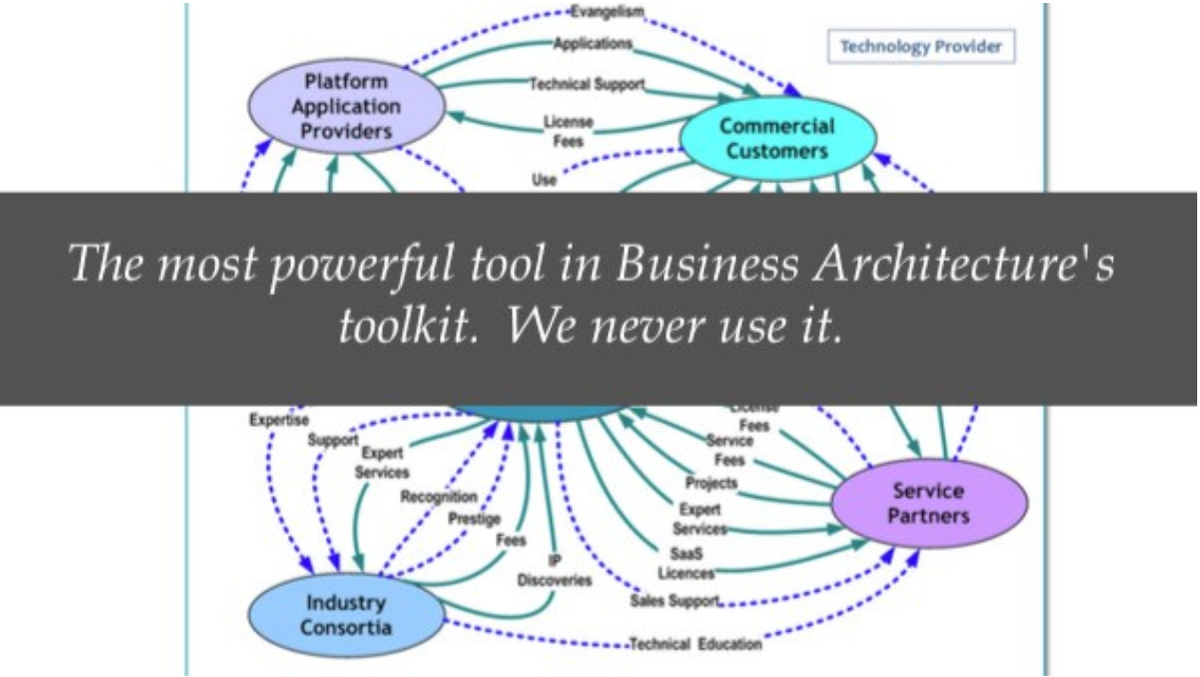
Verna Allee understood this. Her Value Network Analysis framework gave us three deceptively simple building blocks:
- Roles — participants in the network (teams, organisations, individuals)
- Transactions — the directional exchanges between those roles
- Deliverables — what passes between them: goods, services, payments (tangible), but also knowledge, trust, reputation, and favours (intangible)
That last word — intangible — is where value networks become genuinely dangerous to conventional thinking.
The Exchange We Never Map
Every governance framework, every operating model, every capability map focuses on tangible exchanges: products, services, money, data. That is what appears in process flows. That is what auditors count.
But intangible exchanges are what actually make or break value creation.
- A risk team gives a business unit trusted sign-off, not just formal approval. The trust is the value.
- A supplier provides institutional knowledge about how a platform really works, not just the contracted service.
- A relationship manager passes client intelligence to an underwriter — quietly, informally, not through any documented process.
- A Board receives confidence from management, not just a pack.
When those intangible exchanges break down, organisations experience symptoms that no capability map can diagnose: slow decisions, unexplained rework, governance that technically functions but produces no real challenge, commercial relationships that deteriorate despite contractual compliance.
A value network makes those exchanges visible. And once visible, they become manageable.
The Connection to What We’ve Already Seen
In a recent article, I argued that the organisation chart is a lie — that the real unit of organisational performance is the collaboration network, not the hierarchy. Value networks are the natural extension of that argument. They show not just who collaborates, but what actually flows between them and what it is worth.
I also argued that Business Architects should stop selling capability maps and start selling decisions. Value networks are a powerful reason why. A capability map shows what an organisation can do. A value network shows the exchanges that determine whether those capabilities produce value at all — and it surfaces decisions naturally, because every broken or missing exchange is a decision waiting to be made.
And in the Duplicate Spend Heatmap piece, I showed how three X’s on a page can reveal duplication hiding in plain sight. A value network goes deeper: it explains why that duplication exists in the first place. Duplication does not arise randomly. It arises because two teams are each trying to compensate for a missing exchange — a piece of knowledge, a trusted decision, a shared data asset — that the network should have provided but didn’t. Fix the network, and the duplication often resolves itself.
Why We Have Left It Alone
There are three honest reasons Business Architecture has underused value networks.
First, they are harder to draw than a capability map. A capability map has boxes. Everyone understands boxes. A value network requires you to identify roles, map the exchanges between them, and — most challenging — distinguish tangible from intangible flows. That takes facilitation skill, not just taxonomic thinking.
Second, intangible exchanges are uncomfortable. Mapping that the real value in a supplier relationship is the knowledge they hold, not the service they provide, is commercially and politically awkward. Capability maps do not produce that kind of discomfort.
Third — and most honestly — value networks make it harder to hide. A capability map can look comprehensive while concealing the fact that nobody has thought about how the capabilities connect to each other. A value network forces that question. It is a more exposing tool. And exposing tools are rarely popular in organisations that prefer the appearance of clarity over the reality of complexity.
What Good Looks Like
A value network exercise in an insurance claims function might reveal:
- Three teams each providing claim intelligence to reserving — but with no common format, no shared trust in the data, and no agreed escalation path when figures conflict.
- A key outsource partner receiving only transactional instructions but providing informal market intelligence that shapes strategy — an intangible exchange entirely absent from the contract and invisible to governance.
- A fraud team passing judgement calls to underwriting through informal channels, creating undocumented risk acceptance that neither team owns.
None of that appears in a process map. All of it appears in a value network. And once visible, all of it is actionable: redesign the exchange, formalise the intangible, assign the ownership.
The Call to Action
Pick one important business service — claims, onboarding, payments — and instead of drawing the capability map first, draw the network.
Map the roles. Map the exchanges. Ask specifically: what intangible value is being transferred here, and what happens when it isn’t?
You will find things that no capability map has ever shown you. And you will have something worth showing to an executive who has stopped responding to box-and-line diagrams: a picture of how value actually flows, and precisely where it is leaking.
Three questions worth sitting with
- When did your organisation last map the intangible exchanges in a critical business service — and what would it find if it did?
- If value networks are this powerful, why has Business Architecture spent the last two decades leading with capability maps instead?
- Which broken exchange in your organisation is responsible for a piece of duplication, friction, or governance failure that everyone has attributed to something else entirely?