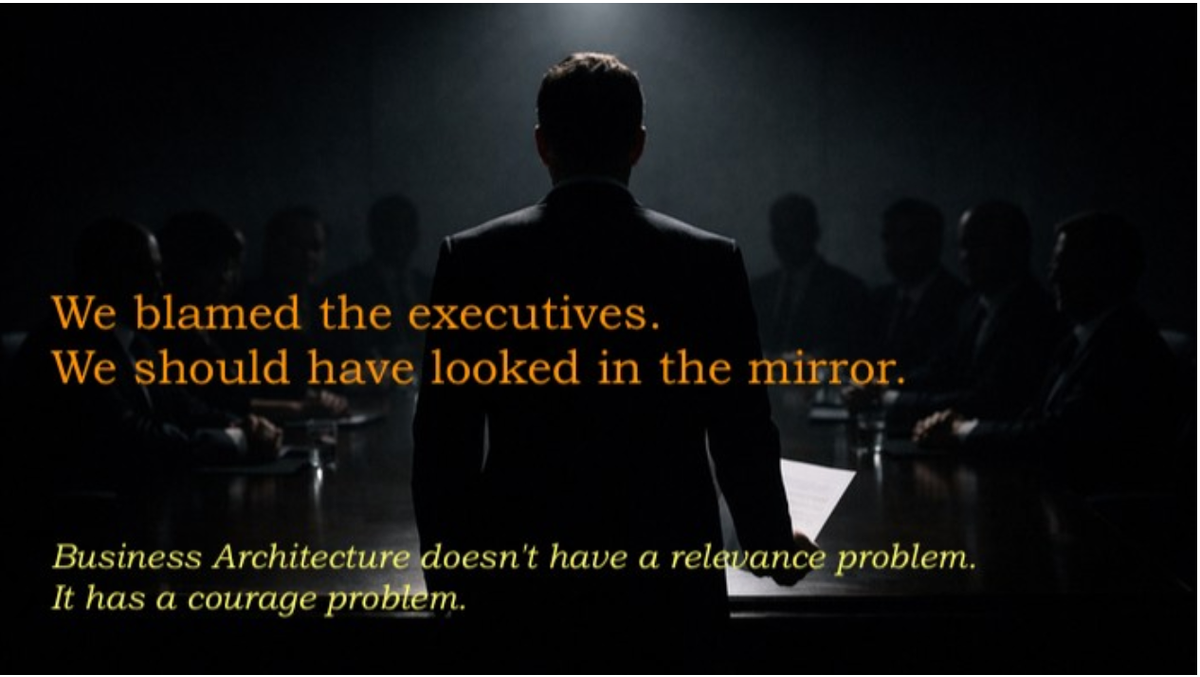
We blamed the executives. We should have looked in the mirror.
In my article published here in September 2025, I asked whether Business Architecture had become the new PMO — an expensive governance layer that slows delivery rather than shaping it. The response was striking. Hundreds of comments, most of them variations of the same frustration: executives don’t get it, they don’t invest in it, they don’t value the enterprise view.
Then last week, I argued that we’d made things worse by leading with capability maps and taxonomy debates instead of decision advantage. Again, the comments came — practitioners nodding, sharing their own versions of the same story.
I’ve been sitting with those responses. And something has been nagging at me.
Both narratives put the problem outside us. The executives are impatient. The language doesn’t land. The culture isn’t ready. All of that is true. But it’s not the whole truth.
Here’s the harder question: how much of Business Architecture’s marginalisation is something we are actively choosing?
What self-censorship looks like in practice
It doesn’t look like cowardice. It looks like professionalism.
- It looks like presenting three options when the evidence clearly points to one — because giving leaders “a choice” feels more respectful than giving them a recommendation.
- It looks like writing a balanced decision paper after a Duplicate Spend Heatmap reveals that two vendors need to go — because the sponsor of one of them is in the governance forum.
- It looks like framing everything as “it depends” to avoid being wrong, and calling that intellectual rigour.
- It looks like producing the capability map that was asked for, even when you know it won’t help anyone make the decision they actually face.
- It looks like softening the finding, hedging the conclusion, and leaving the room having said nothing that made anyone uncomfortable — and calling that stakeholder management.
I’ve done versions of all of these. Most experienced Business Architects have. The question is whether we’re honest about what it actually is: conflict avoidance, dressed up as methodology.
Where it comes from — and why it makes sense
This isn’t a character flaw. It’s a learned response to a real environment.
BA functions that have been cut or restructured before learn that visibility is dangerous. Once you’ve been absorbed into a PMO or had your team halved after a reorganisation, you learn to survive by being agreeable. You stop saying uncomfortable things because the last time you did, it didn’t end well.
Organisations that punish the messenger create practitioners who stop delivering hard messages. And the discipline’s love of frameworks and artefacts gives perfect cover — you can look credible and busy without ever saying anything that puts you at risk.
The PMO trap I described earlier makes this worse. Once Business Architecture is perceived as a governance overhead, it fights for survival by becoming useful to whoever holds the budget. And “useful” in that context often means “not threatening.”
Learned responses can be unlearned. But first, we have to name them honestly.
What courage actually looks like — in practice, not in principle
I’m not talking about recklessness. I’m not suggesting Business Architects should walk into executive forums and deliver verdicts without evidence or relationship.
I’m talking about something more specific:
- Write the one recommendation, not three options, when the evidence clearly points one way — and put your name on it. If the heatmap shows that Vendor A duplicates Vendor B and the payback is under twelve months, say so. Don’t write “consolidation is one option the organisation may wish to consider.”
- Tell the sponsor their initiative duplicates something already funded. Even when they don’t want to hear it. Especially when they don’t want to hear it. That’s the enterprise view. That’s the job.
- Publish the before/after results — including when the savings didn’t materialise as promised. The credibility that comes from honest measurement is worth more than the comfort of leaving outcomes vague.
- Say “this capability map won’t help you make this decision” rather than producing it anyway. The previous article argued we should stop selling artefacts and start selling decision advantage. That only works if we’re willing to decline the artefact request.
None of this is comfortable. All of it is what distinguishes a trusted adviser from an expensive documenter.
The question I’d like to leave with you
The comments on the PMO article were full of legitimate frustration — executives who don’t invest, organisations that don’t listen, cultures that resist the enterprise view.
This time, I want to ask something different.
When did you last tell an executive something they didn’t want to hear — and stand behind it when they pushed back?
And if the honest answer is “not recently” — what stopped you? Was it the culture? The politics? The fear of what happens next?
Or was it something quieter: the habit of making ourselves palatable, built up over years of watching what happens to people who aren’t?
Business Architecture will earn its permanent seat at the table when it starts saying things that make rooms uncomfortable. Not without evidence. Not without relationships. But clearly, with a recommendation, and with a name attached to it.
Until then, we will keep writing articles about why executives don’t understand us.
And they will keep being right.
This is the third in a series exploring why Business Architecture underperforms despite its potential. Earlier pieces: “Has Business Architecture Become the New PMO?” and “Capability Maps Don’t Win Hearts. Decision Advantage Does.”