Reimagining Insurance Operating Models in the Age of AI, Open Finance and Embedded Insurance
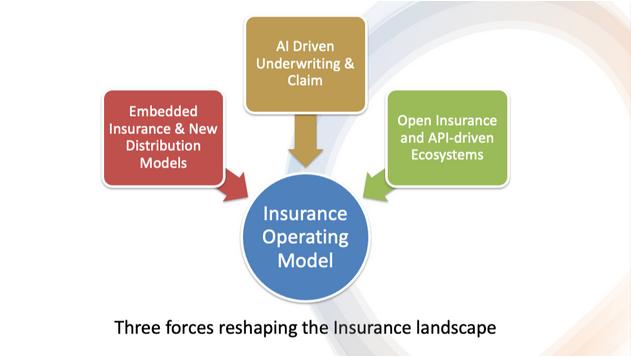
The insurance industry is undergoing one of the most significant shifts in its history. Traditional operating models were designed for scale, control and efficiency, but they are now being tested by forces that are reshaping the entire landscape.
Customers expect personalised, seamless and mobile-first experiences. Regulators demand greater transparency and resilience. At the same time, advances in AI, thegrowth of open finance and the emergence of embedded ecosystems are changing the way insurers create and deliver value.
It is becoming increasingly clear that the models which served us well for decades are no longer sufficient.
Three Forces Reshaping Insurance
AI driven underwriting and claims
Artificial Intelligence (AI) is rapidly transforming risk assessment and claims management. Smarter data driven insights are improving pricing, reducing leakage and speeding up decision-making. Insurers that integrate AI effectively into their operations are able to improve both efficiency and customer experience.
Open insurance and API-driven ecosystems
Open finance is enabling new partnerships between insurers, fintechs and ecosystem players. APIs have become the foundation for innovation, allowing data to flow seamlessly and enabling the creation of new, customer-focused products and services.
Embedded insurance and new distribution models
Insurance is increasingly being purchased at the point of need, whether customers are shopping online, booking travel or using mobility services. This shift requires insurers to rethink how they design products, manage partnerships and integrate capabilities into third-party ecosystems.
Why Adaptive Operating Models are Essential
From my work across commercial, personal and specialty lines, I have seen how legacy structures can slow down transformation. Having worked with leading insurance businesses, I have been closely involved in shaping digital-first strategies and redesigning operating models to enable better customer and business outcomes.
What differentiates organisations that succeed is not technology alone. It is the ability to design adaptive operating models that:
- Align business, data and technology capabilities with customer outcomes.
- Allow rapid experimentation while maintaining control and governance.
- Embed innovation into the core of the business rather than treating it as an add-on.
Insurers that can deliver these capabilities will be in a much stronger position to compete as ecosystems evolve and customer expectations continue to rise.
Looking Ahead
AI, open finance and embedded ecosystems are redefining the boundaries of insurance. The shift from product-centric models to experience-centric models is well underway. The real challenge now is not whether operating models should change, but how quickly and effectively organisations can adapt.
I would be interested to hear how others in the industry are approaching this.
- How is your organisation adapting its operating model?
- Which capabilities are proving most critical to compete and thrive?