The Fifteen Patterns Behind Every Service
This article introduces the fifteen patterns that underpin every large public service estate, grouped into five families, with worked examples showing how they combine to build complete services.
Most business capability models end up in a SharePoint folder. Technically correct. Practically invisible. This article challenges that orthodoxy, not to dismiss it, but to ask whether it is the right starting point for every organisation. And to propose something more accessible in its place.
Twelve service design teams. Over 200 services. A design authority that kept asking whether different services were not, in fact, the same service in a different context. Service designers who disagreed. Business architects who found that both sides were right. The article that explains how.
Service patterns get confused with user stories, process maps, design components, and service blueprints. They are none of these things. They occupy a specific layer of service architecture that most organisations have never named.
Large organisations design the same service interactions from scratch, with no shared vocabulary and no institutional memory resulting in inconsistency. Service patterns can changes this.
Business architecture keeps failing in the same place. Not because the model is wrong, but because it was built to ignore the code the organisation actually runs on. This is the fifth and final article in The Missing Domain series — and the one that says what to do about it.
There is a version of this story I have told at conference tables in which the lesson is about stakeholder management. The engagement succeeded. The client was satisfied. That version is true. It is also incomplete in a way that matters.
The profession's standard defence is that culture is too soft to map. That defence is wrong. Not subtly wrong. Empirical frameworks for characterising organisational culture have existed for decades. Business architecture has simply chosen not to look at them.
Every organisation has three cultures. The one in the mission statement. The one in the policy documents. And the one that shows up when the stakes are real. Most transformation programmes design for the first two. The third one is the one that decides whether your programme lives or dies.
In 2016, a textbook-correct transformation at a Channel Islands wealth firm collapsed two weeks after go-live. The reason was not in any of the frameworks we had used. It was in the one component business architecture refuses to map.
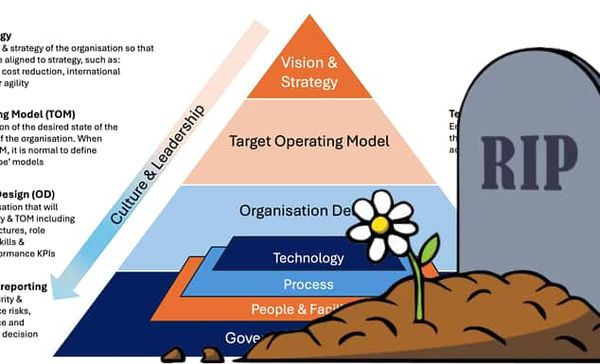
The target operating model is one of the most widely used artefacts in business architecture. It is also an artefact that the world no longer respects. What if the problem is not the TOM itself, but the five-year cadence and mega-programme delivery we keep wrapping around it?
There is a moment I have encountered in almost every transformation programme I have worked on. It happens in a workshop, or a design review, or sometimes in a corridor conversation that nobody planned. Someone asks a question that stops the room. Not a hostile question. Not a political one.
Operating Model
Before I turn to the professional analysis in this article, I want to be honest about the context. The conflict that began on 28 February 2026 has cost thousands of lives. But its consequences have reached into the daily lives of people far beyond the conflict zone. Fuel rationing has
Organisational Debt
In this series I have argued that organisation debt — the accumulated cost of poor structures, deferred decisions, broken processes, and ungoverned data — is a real liability that belongs on the management agenda alongside financial and technical debt. In Part II, I introduced a practical taxonomy: Decision Debt, Control Debt, Data
AI & Automation
Ask a senior executive whether their organisation has an AI operating model and the answer will almost certainly be: “We’re working on it.” They are wrong. The model already exists. It is just not the one anyone designed. Over the past two years, most organisations have accumulated a sprawling,
Business Architecture
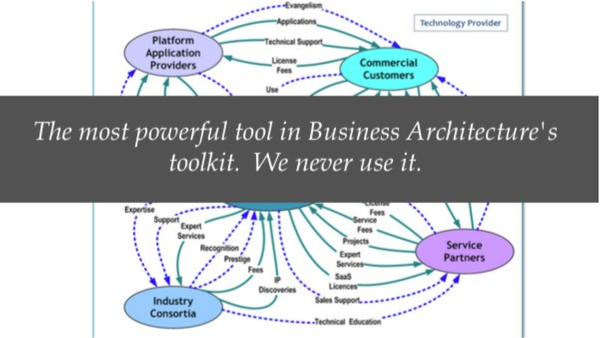
Value networks have sat in our discipline for decades. We walked right past them. Business Architecture has a problem with its own toolkit. We have spent two decades convincing organisations that capability maps are the answer. When that didn’t stick, we rebranded to value streams. When that felt too
Operating Model
Here is a thought experiment. Take your organisation's most complex delivery challenge last year — a regulatory programme, a product launch, a major incident. Now look at the org chart. How many of the people who actually solved it report to the same box? Very few, I would wager.
Business Architecture
In my article published here in September 2025, I asked whether Business Architecture had become the new PMO — an expensive governance layer that slows delivery rather than shaping it. The response was striking. Hundreds of comments, most of them variations of the same frustration: executives don’t get it, they
Business Architecture
Business Architecture doesn’t fail because stakeholders “don’t get capabilities.” It fails when we try to sell the discipline, instead of landing the insight. After 20+ years working across financial services, public sector and utilities, I’ve repeatedly seen the same adoption trap: * In many organisations, the word “capability”
Future of Work
In my previous article, “Hybrid Isn’t About Office Days. It’s About How Decisions and Controls Work,” I argued that hybrid working is not primarily a workplace policy. It is an operating model choice—and operating model choices determine whether execution stays reliable: how decisions are made, how controls
AI & Automation
AI is now a Board-level topic in UK financial services - not because it is new, but because it is becoming embedded in real decisions that affect customers, markets, and operational resilience. In January 2026, the Treasury Committee warned that the current approach to AI risks exposing consumers and the
Future of Work
Across the UK (and globally), more organisations are recalibrating hybrid working and raising minimum in-office expectations after several years of flexibility. In UK financial services, for example, several large firms have publicly tightened attendance baselines—often moving from two to three in-office days for many roles. Industry research
Regulation & Resilience
Prudential Regulatory Authrity published its latest Supervisory Statement (SS5/25: “Enhancing banks’ and insurers’ approaches to managing climate-related risks”) in December 2025. It refreshes supervisory expectations first set in SS3/19 while positioning climate-related risk as a core prudential and operational resilience issue that must be embedded into
Regulation & Resilience
On 31 March 2025, the UK operational resilience transition period ended. For many firms, that date quietly changed the question from “Are we ready for the deadline?” to “Can we keep proving we’re resilient—week in, week out?” That distinction matters. Programmes finish. Resilience does not. The FCA’s